Burst Pipe Water Damage in the USA
Burst Pipe Water Damage begins when pressurized supply lines fail due to corrosion, joint separation, or thermal expansion. Water escapes under pressure and travels along framing, subfloors, and insulation, raising moisture content far beyond the initial leak point. Our technicians first locate the active source, isolate the line, and begin extraction before humidity drives further wicking into adjacent cavities.
Once standing water is removed, evaporation rates must be managed so that relative humidity in the affected space stays below the threshold that supports mold growth on cellulose materials. Splash Pro Water Damage Restoration deploys air movers and dehumidifiers in measured patterns to pull moisture from saturated drywall, carpet padding, and base plates without forcing vapor deeper into wall cavities. Air circulation patterns determine how quickly Splash Pro Water Damage Restoration can reduce moisture content after burst pipe water damage incidents in the USA.
Observable Indications of an Active Burst
- Sudden reduction in water pressure at multiple fixtures
- Discolored streaks forming along ceiling drywall seams
- Warm or cold spots on flooring that feel damp to touch
- Audible hissing or dripping inside walls near shutoff valves
- Swelling baseboards or buckling hardwood at floor transitions
Common Pipe Failure Points
Older galvanized or copper lines develop pinhole leaks where mineral deposits erode the interior wall. Solder joints weaken after repeated freeze-thaw cycles, allowing pressurized water to spray outward. Our technicians examine pipe routing behind appliances and in crawl spaces to identify the exact breach before extraction begins.
PEX and CPVC lines can split when expansion tanks fail or when nails from remodeling puncture the tubing. Each material requires different shutoff procedures to stop flow without creating additional leaks elsewhere in the system.
Inspection and Moisture Measurement Sequence
Technicians start at the visible water line and move outward, using penetrating and non-penetrating meters to record moisture percentages in drywall, subfloor, and framing. Thermal imaging reveals temperature differentials that indicate hidden saturation behind cabinets or under tile. Readings are logged at multiple heights to map the vertical migration caused by capillary action.
Attention focuses on areas where plumbing intersects electrical boxes or HVAC returns, because moisture in these cavities can travel through ductwork and affect distant rooms. All data determines the placement of drying equipment and the sequence of demolition if needed.
Drying Equipment and Material Removal
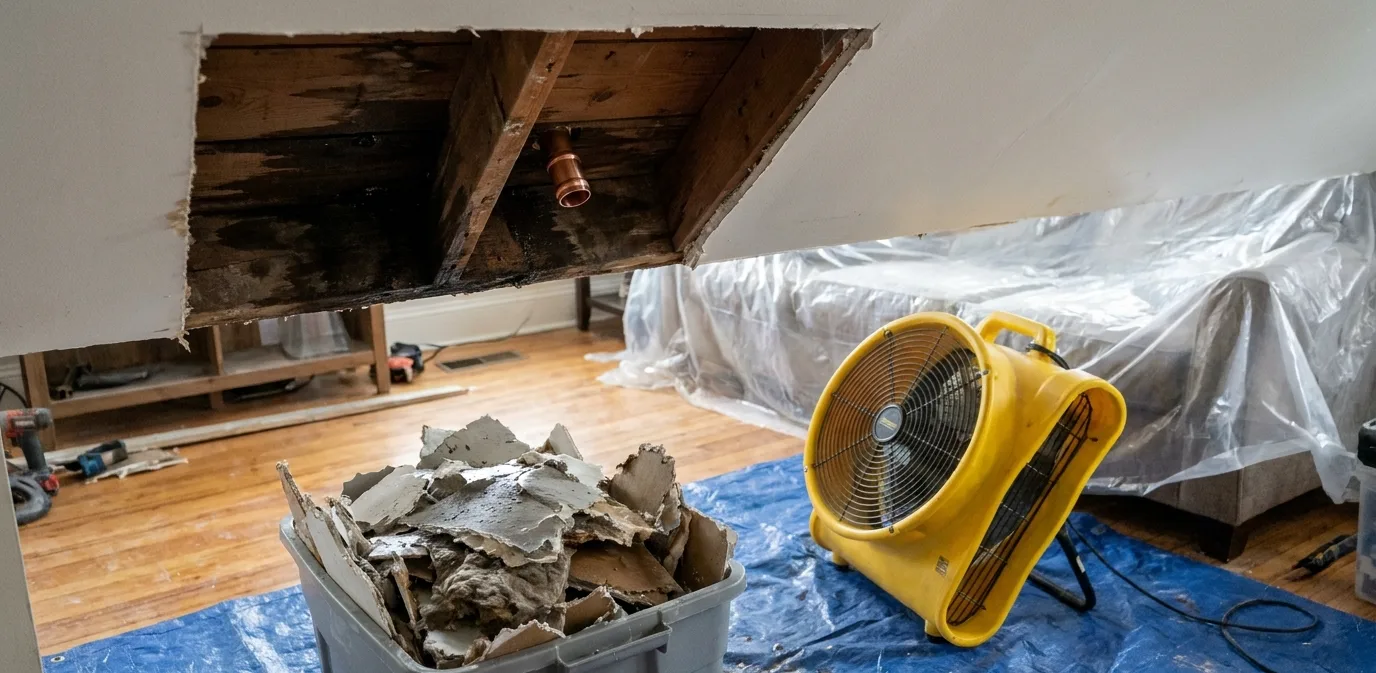
After extraction, air movers are positioned to create directed airflow across wet surfaces while dehumidifiers maintain vapor pressure gradients that pull moisture outward. Technicians monitor grains per pound and adjust equipment daily until equilibrium moisture content is restored in the structure.
Saturated carpet padding and drywall below the water line are removed to eliminate wicking reservoirs. Base plates and insulation are inspected for delamination; affected sections are cut out so that drying can reach the full depth of the remaining assembly.
Pipe Repair and Rebuild Options
Technicians replace the failed section with matching material and install accessible shutoff valves where none existed. In cases of widespread corrosion, a full repipe using PEX may be recommended to reduce future failure risk while minimizing wall disturbance.
After drying is verified, new drywall and trim are installed to match existing finishes. Final moisture readings confirm that all cavities have returned to acceptable levels before any surface restoration proceeds.
Burst Pipe Water Damage questions
How do I stop water flow from a burst pipe safely?
Locate the main shutoff valve, usually near the water meter or where the line enters the building, and turn it clockwise until it stops. Avoid opening walls or attempting temporary clamps until the supply is isolated, because additional movement can enlarge the breach.
What moisture levels require professional drying equipment?
Drywall above 17 percent and wood framing above 15 percent moisture content indicate the need for mechanical drying. These thresholds prevent microbial growth while allowing evaporation to continue under controlled humidity conditions managed by dehumidifiers.
Can hidden moisture remain after visible water is gone?
Water migrates along the bottom plate and into subfloor seams, raising humidity in wall cavities that feel dry on the surface. Moisture meters and infrared scans detect these pockets so that drying can continue until equilibrium is reached throughout the assembly.
When should flooring be removed during Burst Pipe Water Damage restoration?
Padding under carpet retains water and must be discarded once saturation exceeds extraction limits. Hardwood or laminate that shows cupping or separation from the subfloor is also removed to allow airflow underneath and prevent permanent distortion.
Schedule Burst Pipe Water Damage Assessment
Contact Splash Pro Water Damage Restoration to begin extraction and drying after a pipe failure anywhere in the USA.